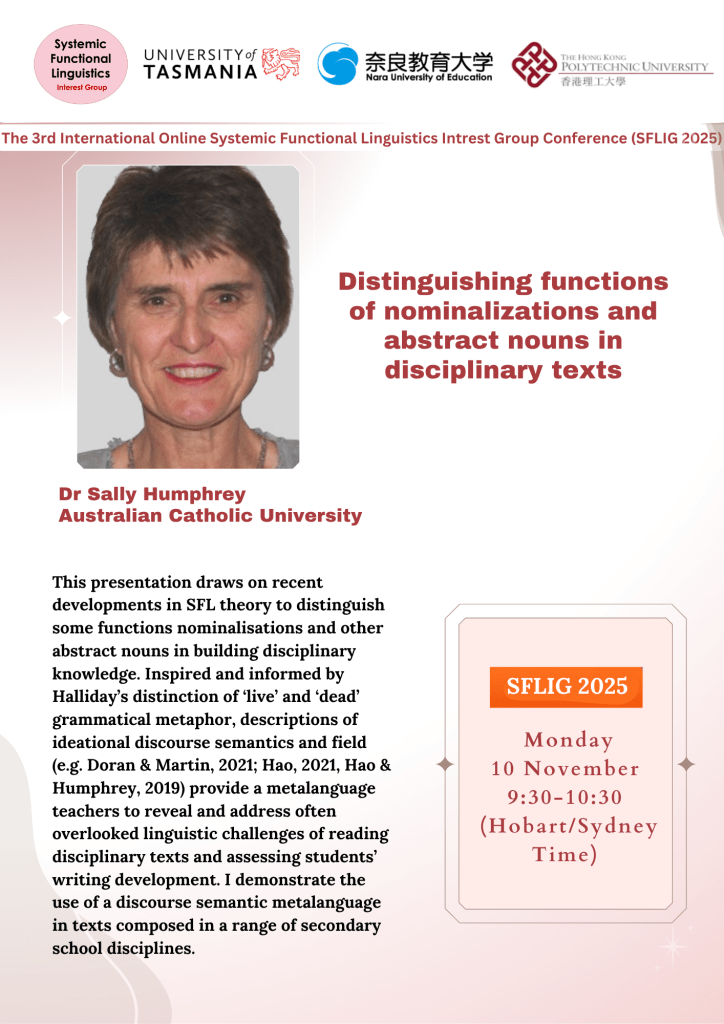
Plenary 1: Distinguishing functions of nominalizations and abstract nouns in disciplinary texts
Dr Sally Humphrey

Abstract
This presentation draws on recent developments in SFL theory to distinguish some functions nominalisations and other abstract nouns in building disciplinary knowledge. Inspired and informed by Halliday’s distinction of ‘live’ and ‘dead’ grammatical metaphor, descriptions of ideational discourse semantics and field (e.g. Doran & Martin, 2021; Hao, 2021, Hao & Humphrey, 2019) provide a metalanguage teachers to reveal and address often overlooked linguistic challenges of reading disciplinary texts and assessing students’ writing development. I demonstrate the use of a discourse semantic metalanguage in texts composed in a range of secondary school disciplines.
Biography
Sally Humphrey is a senior lecturer in literacy education at the Australian Catholic University in New South Wales. Sally has worked for many years as a TESOL and languages teacher, teacher trainer and educational linguist in Australia and internationally. She has been involved in research using systemic functional linguistics for over thirty years, particularly to describe the literacy demands of a range of educational and social contexts. She has contributed to a number of influential research projects led by Professors James Martin, Frances Christie, Beverley Derewianka and Len Unsworth and contributed to many research publication. Sally has also co-written a number of tertiary level text.
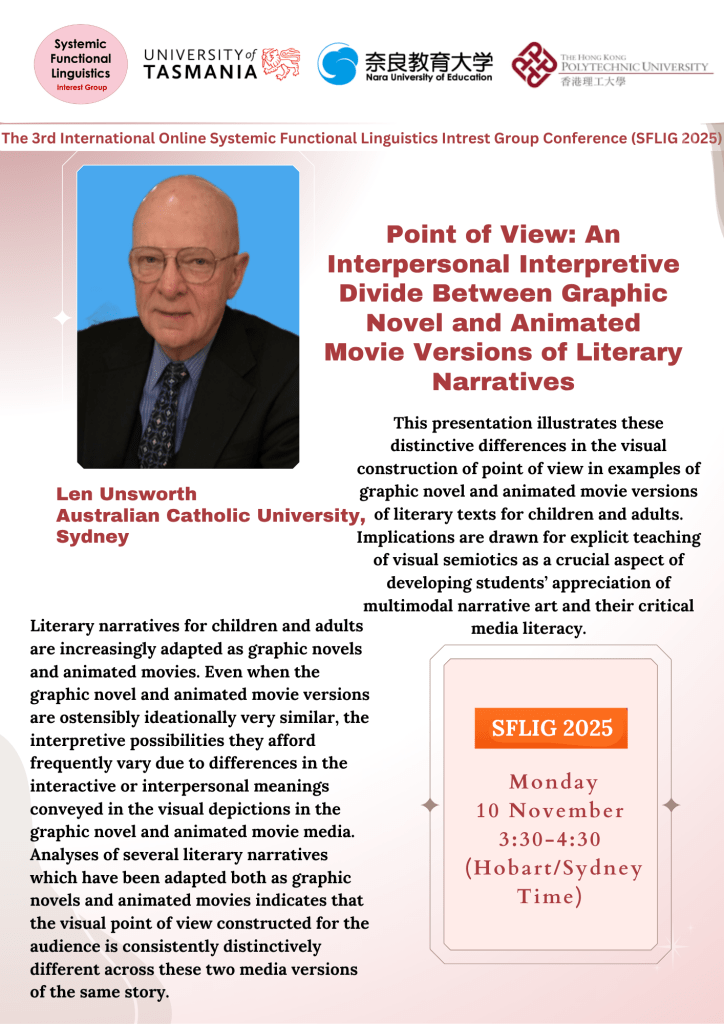
Plenary 2: Point of view: An interpersonal interpretive divide between graphic novel and animated movie versions of literary narratives.
Professor. Len Unsworth, Australian Catholic University

Abstract
Literary narratives for children and adults are increasingly adapted as graphic novels and animated movies. Even when the graphic novel and animated movie versions are ostensibly ideationally very similar, the interpretive possibilities they afford frequently vary due to differences in the interactive or interpersonal meanings conveyed in the visual depictions in the graphic novel and animated movie media. Analyses of several literary narratives which have been adapted both as graphic novels and animated movies indicates that the visual point of view constructed for the audience is consistently distinctively different across these two media versions of the same story. This presentation illustrates these distinctive differences in the visual construction of point of view in examples of graphic novel and animated movie versions of literary texts for children and adults. Implications are drawn for explicit teaching of visual semiotics as a crucial aspect of developing students’ appreciation of multimodal narrative art and their critical media literacy.
Biography
Len Unsworth is Professor in English and Literacies Education at the Australian Catholic University in Sydney. Len’s current research interests include systemic functional semiotic perspectives on multimodal and digital literacies in English and in curriculum area teaching and learning. He has been a chief investigator on eleven large national Australian Research Council funded projects since 2005, and has published extensively in leading journals in literacy and education as well book chapters and a number of books, including: Reading Images for Knowledge Building in School Science – with Jim Martin (Routledge, 2024);Functional Grammatics: Reconceptualising Knowledge about Language and Image for School English with Mary Macken-Horarik, Kristina Love and Carmel Sandiford (Routledge, 2017);English Teaching and New Literacies Pedagogy, with Angela Thomas (Peter Lang Publishing 2014); and Reading Visual Narratives (Equinox, 2013) with Clare Painter and Jim Martin.
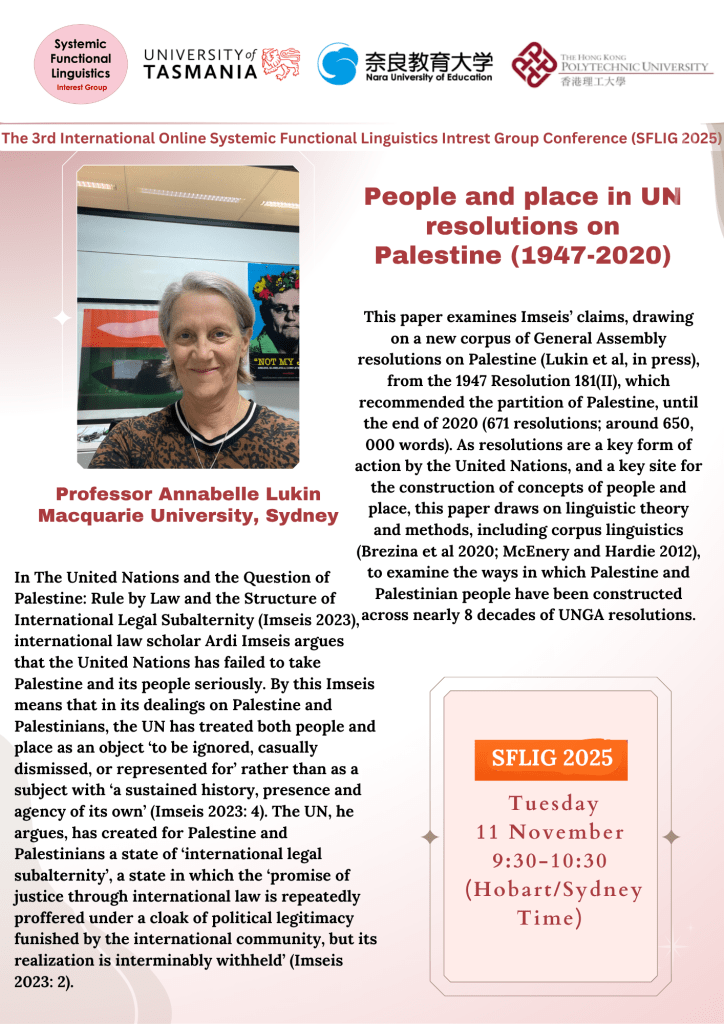
Plenary 3: People and place in UN resolutions on Palestine (1947-2020)
Professor Annabelle Lukin, Macquarie University
Abstract
In The United Nations and the Question of Palestine: Rule by Law and the Structure of International Legal Subalternity (Imseis 2023), international law scholar Ardi Imseis argues that the United Nations has failed to take Palestine and its people seriously. By this Imseis means that in its dealings on Palestine and Palestinians, the UN has treated both people and place as an object ‘to be ignored, casually dismissed, or represented for’ rather than as a subject with ‘a sustained history, presence and agency of its own’ (Imseis 2023: 4). The UN, he argues, has created for Palestine and Palestinians a state of ‘international legal subalternity’, a state in which the ‘promise of justice through international law is repeatedly proffered under a cloak of political legitimacy funished by the international community, but its realization is interminably withheld’ (Imseis 2023: 2). This paper examines Imseis’ claims, drawing on a new corpus of General Assembly resolutions on Palestine (Lukin et al, in press), from the 1947 Resolution 181(II), which recommended the partition of Palestine, until the end of 2020 (671 resolutions; around 650, 000 words). As resolutions are a key form of action by the United Nations, and a key site for the construction of concepts of people and place, this paper draws on linguistic theory and methods, including corpus linguistics (Brezina et al 2020; McEnery and Hardie 2012), to examine the ways in which Palestine and Palestinian people have been constructed across nearly 8 decades of UNGA resolutions.
Biography
Annabelle Lukin is Professor of Linguistics at Macquarie University in Sydney. She researches language in diverse contexts including politics and media, international war law, healthcare communication, and the climate crisis. Her major publication is War and Its Ideologies: A Social-Semiotic Theory and Description (Springer, 2019), based on over a decade of research into media reporting of the 2003 invasion of Iraq. She has a Substack newsletter where she writes about language in the climate crisis.
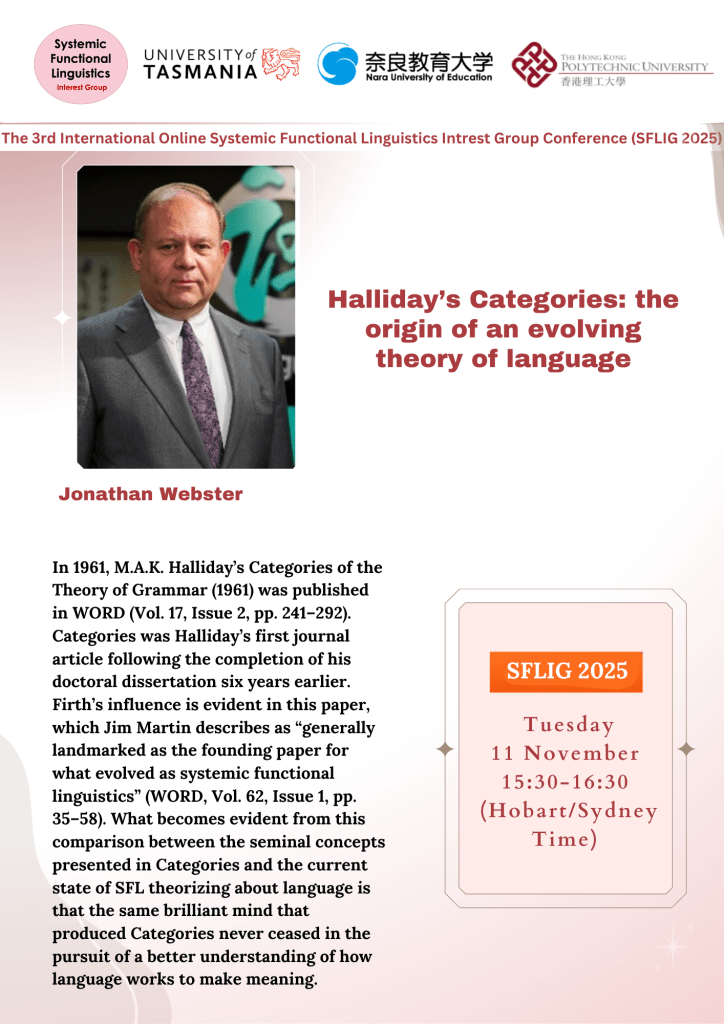
Plenary 4 : Halliday’s Categories: the origin of an evolving theory of language
Professor Jonathan Webster

Abstract
In 1961, M.A.K. Halliday’s Categories of the Theory of Grammar (1961) was published in WORD (Vol. 17, Issue 2, pp. 241–292). Categories was Halliday’s first journal article following the completion of his doctoral dissertation six years earlier. Firth’s influence is evident in this paper, which Jim Martin describes as “generally landmarked as the founding paper for what evolved as systemic functional linguistics” (WORD, Vol. 62, Issue 1, pp. 35–58). What becomes evident from this comparison between the seminal concepts presented in Categories and the current state of SFL theorizing about language is that the same brilliant mind that produced Categories never ceased in the pursuit of a better understanding of how language works to make meaning.
Biography
For more than ten years, Jonathan Webster headed up the Department of Chinese, Translation and Linguistics at City University of Hong Kong (CityU). He has served as the Editor of the Collected Works of several leading scholars, including M.A.K Halliday, Ruqaiya Hasan, Sydney Lamb, and Braj B. Kachru. He authored the book Understanding Verbal Art: A Functional Linguistic Approach, published by Springer; and co-authored (with M.A.K. Halliday) Text Linguistics: The how and why of meaning, published by University of Toronto Press. In addition, he is the founding Editor of Linguistics and the Human Sciences (University of Toronto Press); and Managing Editor of the journal WORD (International Linguistic Association and Taylor & Francis).
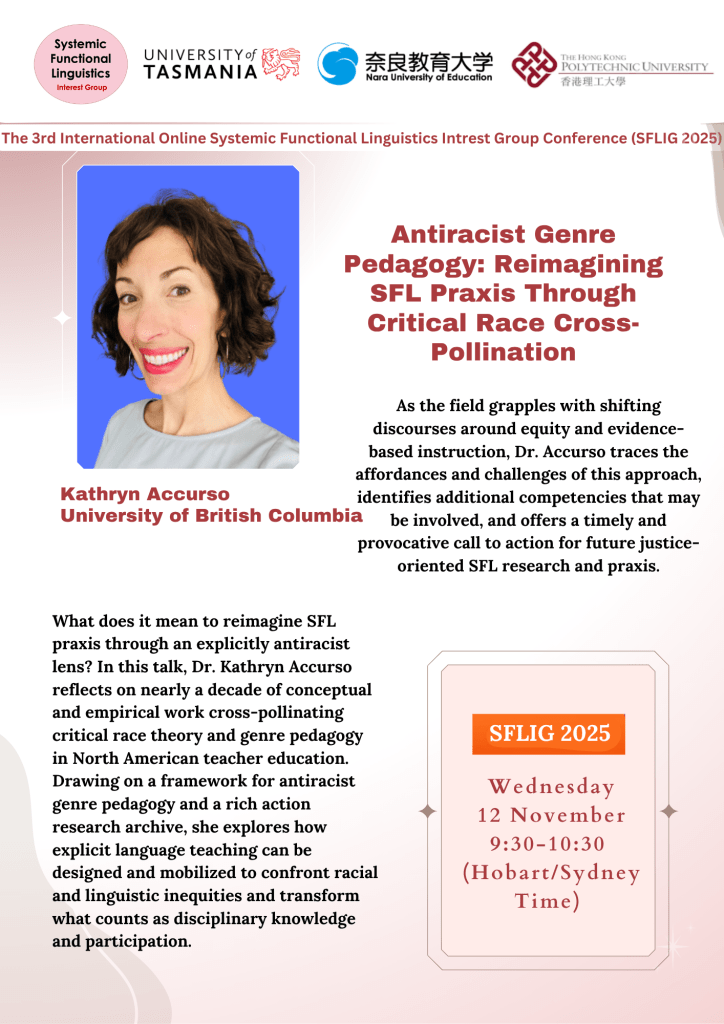
Plenary 5: Antiracist Genre Pedagogy: Reimagining SFL Praxis Through Critical Race Cross-Pollination
Dr Kathryn Accurso, University of British Columbia

Abstract
What does it mean to reimagine SFL praxis through an explicitly antiracist lens? In this talk, Dr. Kathryn Accurso reflects on nearly a decade of conceptual and empirical work cross-pollinating critical race theory and genre pedagogy in North American teacher education across K–12 and adult learning contexts. At the core of this work is a framework for antiracist genre pedagogy, which seeks to break disciplinary silences on the racialized and racializing nature of ‘academic language’ and support teachers to consciously change the system of meaning-making choices used, taught, and valued in school settings. This presentation traces affordances and challenges of mobilizing an antiracist genre pedagogy framework to confront racial and linguistic inequities in language/literacies education and teacher preparation.
The talk draws on a rich action research dataset that includes five years of written, oral, and multimodal reflections on antiracist genre pedagogy by pre- and in-service teachers; curriculum they designed; and instructor interviews/memos. Findings from a critical race reflexive thematic analysis of these data point to: (1) affordances such as increased critical disciplinary consciousness, antiracist dispositions, deeper engagement with diverse voices for learning, and intentional curriculum design that foregrounds equity; (2) challenges such as navigating institutional constraints, developing racial literacy alongside genre knowledge, and sustaining critical reflexivity over time; (3) additional competencies that may be involved (e.g., trauma-informed practices, understandings of harm and reconciliation, discourse-level analysis of power, collaborative curriculum design); and (4) directions for future research and praxis as the pursuit of justice now continues in the context of shifting discourses and commitments toward equity, diversity, inclusion and hyperfixation on narrow forms of ‘evidence-based’ language/literacies instruction.
Biography
Kathryn Accurso is an Associate Professor of Teaching Multilingual Learners in the Department of Language and Literacy Education at the University of British Columbia. Her work focuses on preparing K–12 educators to support multilingual learners’ engagement, growth, critical thinking, and well-being. She engages antiracist approaches to disciplinary literacies, SFL and genre pedagogy, and action research as a tool for professional development that helps teachers support diverse learners in engaging with, acquiring, critiquing, and reimaging knowledge and language across subjects.
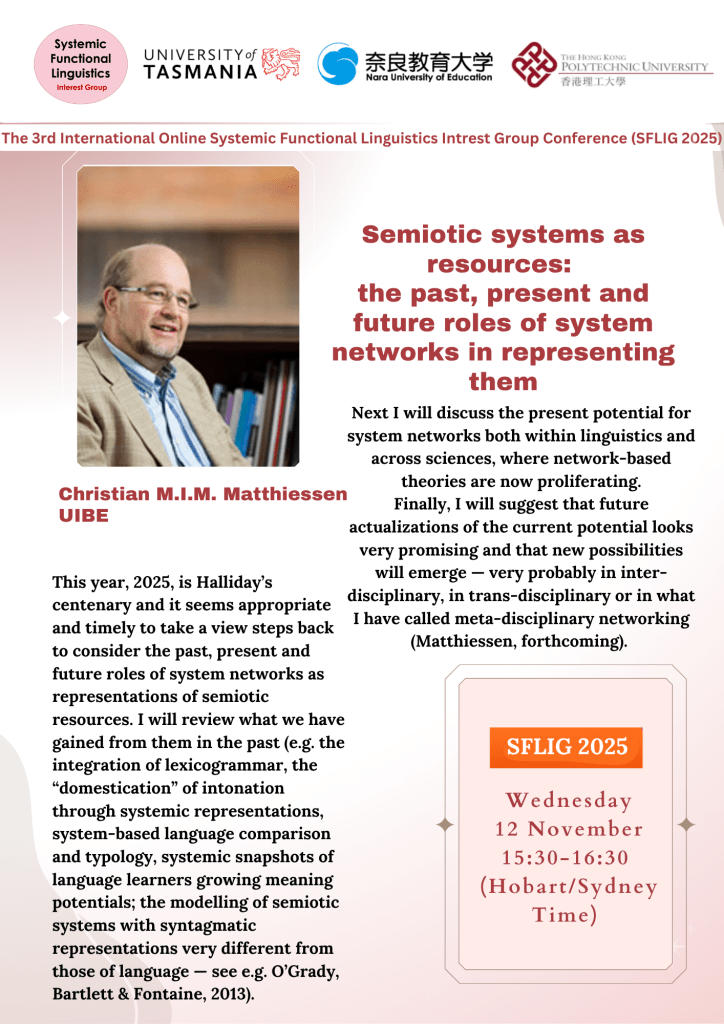
Plenary 6: Semiotic systems as resources: the past, present and future roles of system networks in representing them
Professor. Christian M.I.M. Matthiessen

Abstract
In Systemic Functional Linguistics (SFL), language is construed as a higher-order semiotic systems — as a resource for making meaning, a meaning potential (e.g. Halliday, 1973, 2013, 2023), and since the 1980s, scholars have used this conception to interpret semiotic systems other than language as well. To represent language as meaning potential, Halliday (e.g. 1964, 1966, 1967, 1967/8, 1969) designed system networks in the 1960s as part of his “axial rethink”, treating the paradigmatic axis as primary rather than the syntagmatic axis. Making the paradigmatic axis the foundation of “semiotic order” was unique among theories of language, the default being to treat the syntagmatic axis as the foundation — represented by constituency or dependency structures (cf. Martin, 2013; Matthiessen, 1995, 2015, 2023; Matthiessen & Teruya, 2024). While other strands within linguistics have caught up or begun to catch up with other aspects of his theory that were “out of phase” with linguistics in the 1960s (e.g. his conception of language as a probabilistic system, his view of lexicogrammar as a continuum rather than as separate modules, his prosodic representation of phonology, his distinction between the general theory of language and descriptions of particular languages, his meaning-oriented account of grammar; and his transcendence of the distinction between theoretical and applied linguistics), SFL is still unique among theories of language in giving priority to the paradigmatic organization to theorize and model language as a resource for making meaning.
This year, 2025, is Halliday’s centenary and it seems appropriate and timely to take a view steps back to consider the past, present and future roles of system networks as representations of semiotic resources. I will review what we have gained from them in the past (e.g. the integration of lexicogrammar, the “domestication” of intonation through systemic representations, system-based language comparison and typology, systemic snapshots of language learners growing meaning potentials; the modelling of semiotic systems with syntagmatic representations very different from those of language — see e.g. O’Grady, Bartlett & Fontaine, 2013).
Next I will discuss the present potential for system networks both within linguistics (e.g. the current exploration of their roles in L2 education, as in Arús-Hita, Matthiessen & Xuan, 2024; Matthiessen & Xuan, 2024) and across sciences, where network-based theories are now proliferating (as in network science, Barabási, 2016). Network-based theories enable researchers to observe, analyse, describe and models systems of various phenomenal orders holistically — network-based systems thinking (cf. Capra & Luisi, 2014; Noble, 2016; Noble & Noble, 2023; Harari, 2024). And they are ideal for investigations based on “big data” (as in corpus linguistics, and so-called Generative AI based on large language models) using techniques of machine (and deep) learning and neural network representation. In educational contexts, teachers and learners can now simulate system networks using various “mind-mapping” applications, which typically enable users to visualize the systemic information by means of different kinds of display (cf. Mohan’s, 1986, demonstration of the value to student of learning to “translate” the representation of bodies of knowledge between different semiotic systems).
Finally, I will suggest that future actualizations of the current potential looks very promising and that new possibilities will emerge — very probably in inter-disciplinary, in trans-disciplinary or in what I have called meta-disciplinary networking (Matthiessen, forthcoming). This will surely include further developments of the use of system networks in L2 education, and more broadly a systemic functional version of contrastive linguistics. The development of neurosemiotics involving SFL will also continue, based on key contributions from Latin America: e.g. Trevisan & García (2019), García & Ibáñez (2023). Hopefully, SFL can play a central role in the next phase of computational linguistics and AI when researchers realize that they need to complement the probabilistic modelling with linguistic theory; this seems quite conceivable since SFL already embodies the probabilistic part as well. As network science continues to develop, it is of course entirely possible that system networks will be replaced or improved by a new more powerful network representation, something foreshadowed by Michael Halliday at ISFC 2002 in Liverpool. If so, the systemic functional theory of paradigmatic organization will be more powerfully realized and the potential for applications will increase.
Biography
Professor. Christian M.I.M. Matthiessen is Professor under the María Zambrano scheme, Complutense University; Distinguished Professor in the Department of Linguistics, UIBE; and Distinguished Professor in the School of Foreign Languages, Hunan University. He has degrees in linguistics from Lund University (BA), where he also studied English, Arabic and philosophy, and in linguistics from UCLA (MA, PhD), and has previously held positions at USC/ Information Sciences Institute, Sydney University, Macquarie University, and the Hong Kong Polytechnic University. He has held visiting appointments at the University of Hamburg and the Brain Science Division of the RIKEN Institute in Tokyo.
He is also Honorary Professor, Beijing Normal University, Beijing, the Australian National University, Canberra, and Guest Professor, University of Science and Technology, Beijing. Matthiessen has lectured and given courses around the world, including in China, Japan, S. Korea, the Philippines, Thailand, Indonesia, India, Greece, Germany, Denmark and the UK, Lebanon, Canada, Colombia, Brazil, Argentina and Chile, and he is involved in a number of international research networks. Matthiessen has authored and co-authored over 15 books and 170 book chapters and journal articles.
With researchers around the world, he is working on health communication, aspects of educational linguistics, language description, registerial cartography, multilingual studies, language arts, the language of space, and the development of Systemic Functional Linguistic theory. The most recent books are Matthiessen (2021), Systemic Functional Linguistics, Part I, edited by K. Teruya; Matthiessen, Wang, Ma & Mwinlaaru (2022), Systemic Functional Insights on Language and Linguistics. Matthiessen & Teruya (2023), Systemic Functional Linguistics: a complete guide (Routledge), Matthiessen (2023), System in Systemic Functional Linguistics: a system-based theory of language. Wang & Ma (2023), Theorizing and Applying Systemic Functional Linguistics Developments by Christian M.I.M. Matthiessen, provides an overview of some domains of his work.
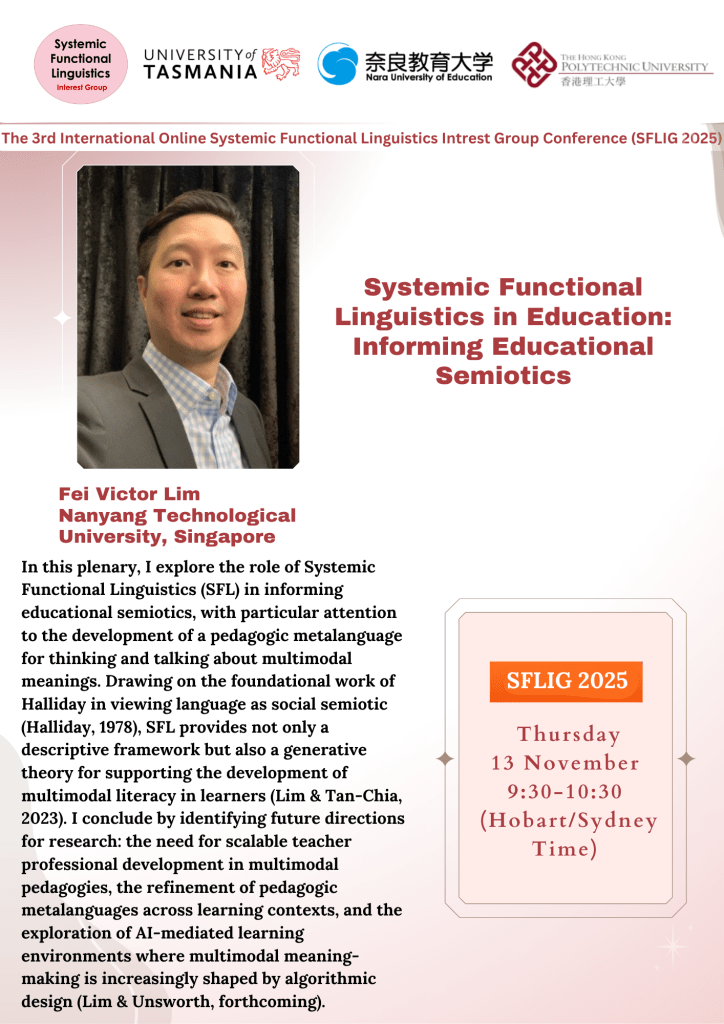
Plenary 7: Systemic Functional Linguistics in Education: Informing Educational Semiotics
Assoc. Prof. Fei Victor Lim, National Institute of Education and Nanyang Technological University
Abstract
The increasing multimodality of contemporary communication demands a rethinking of how we conceptualise literacy in education (New London Group, 1996). From digital news interfaces to interactive video games, from cinematic texts to educational websites and student-designed posters, meaning is no longer conveyed through language alone. In this plenary, I explore the role of Systemic Functional Linguistics (SFL) in informing educational semiotics, with particular attention to the development of a pedagogic metalanguage for thinking and talking about multimodal meanings. Drawing on the foundational work of Halliday in viewing language as social semiotic (Halliday, 1978), SFL provides not only a descriptive framework but also a generative theory for supporting the development of multimodal literacy in learners (Lim & Tan-Chia, 2023). I conclude by identifying future directions for research: the need for scalable teacher professional development in multimodal pedagogies, the refinement of pedagogic metalanguages across learning contexts, and the exploration of AI-mediated learning environments where multimodal meaning-making is increasingly shaped by algorithmic design (Lim & Unsworth, forthcoming).
Biography
Dr Fei Victor Lim is Associate Professor and Deputy Head (Research), English Language and Literature, at the National Institute of Education, Nanyang Technological University, Singapore. He researches and teaches on multiliteracies, multimodal discourse analyses, and digital learning. He is an editor of Multimodality and Society and an associate editor of Computers and Composition and Designs for Learning. He is also author of the book, Designing Learning with Embodied Teaching: Perspectives from Multimodality, lead author of the book, Designing Learning for Multimodal Literacy: Teaching Viewing and Representing. He has received awards for his excellence in research, teaching and service.
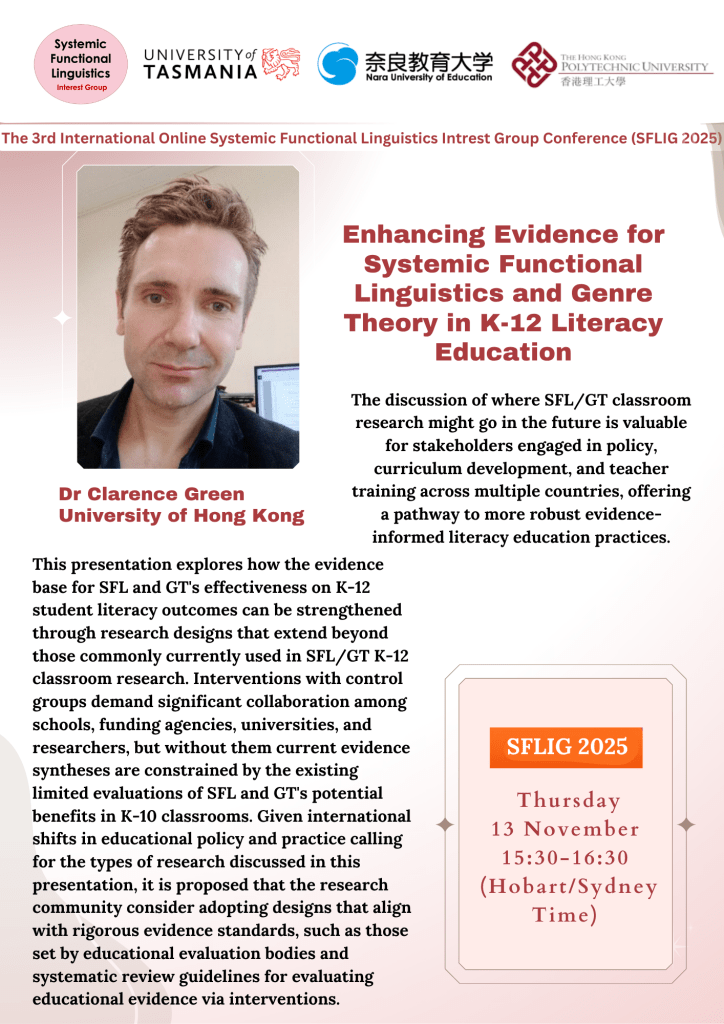
Plenary 8: Enhancing Evidence for Systemic Functional Linguistics and Genre Theory in K-12 Literacy Education
Assoc. Prof. Clarence Green, University of Hong Kong

Abstract
Systemic Functional Linguistics (SFL) and Genre Theory (GT) have influenced decades of research in first and second-language literacy education. However, recent systematic reviews highlight a gap in large-scale interventions and controlled trials evaluating their impact (Green et al., 2024). This presentation explores how the evidence base for SFL and GT’s effectiveness on K-12 student literacy outcomes can be strengthened through research designs that extend beyond those commonly currently used in SFL/GT K-12 classroom research. Interventions with control groups demand significant collaboration among schools, funding agencies, universities, and researchers, but without them current evidence syntheses are constrained by the existing limited evaluations of SFL and GT’s potential benefits in K-10 classrooms. Given international shifts in educational policy and practice calling for the types of research discussed in this presentation, it is proposed that the research community consider adopting designs that align with rigorous evidence standards, such as those set by educational evaluation bodies (e.g., What Works Clearinghouse) and systematic review guidelines for evaluating educational evidence via interventions. The discussion of where SFL/GT classroom research might go in the future is valuable for stakeholders engaged in policy, curriculum development, and teacher training across multiple countries, offering a pathway to more robust evidence-informed literacy education practices.
Biography
Dr Clarence Green is an Assistant Professor, Faculty of Education, University of Hong Kong. His research focusses on vocabulary, reading, first and second language acquisition, language psychology and disciplinary literacy. He holds a PhD (University of Melbourne), and was formerly a k-12 teacher (Victorian Institute of Teachers, Ontario College of Teachers). He co-chairs the Australian Linguistics Society’s ‘Linguistics in the Schools’ SIG, is Associate Editor of the Asia Pacific Journal of Education, and editorial board member of the Journal of English for Academic Purposes and Australian Journal of Linguistics. He received the 2025 recipient of the UKLA/Wiley Research in Literacy Education Award. Email: cgreen@hku.hk
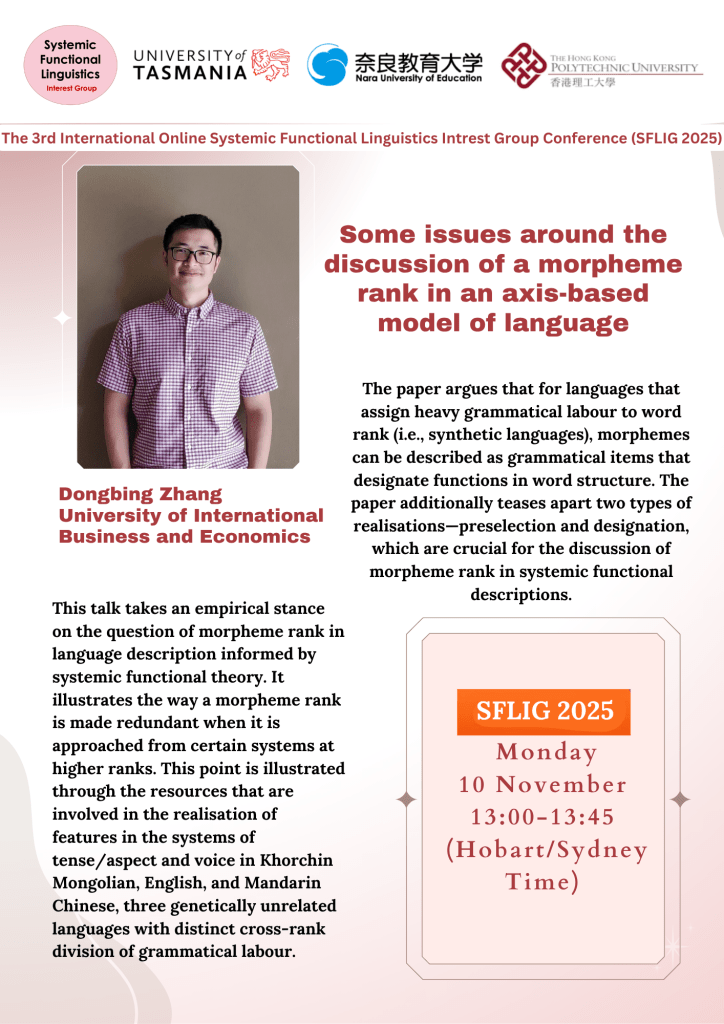
Keynote 1: Some issues around the discussion of a morpheme rank in an axis-based model of language
Assoc. Prof. Dongbing Zhang, University of International Business and Economics

Abstract
The talk takes an empirical stance on the question of morpheme rank in language description informed by systemic functional theory. It illustrates the way a morpheme rank is made redundant when it is approached from certain systems at higher ranks. This point is illustrated through the resources that are involved in the realisation of features in the systems of tense/aspect and voice in Khorchin Mongolian, English, and Mandarin Chinese, three genetically unrelated languages with distinct cross-rank division of grammatical labour. The paper argues that for languages that assign heavy grammatical labour to word rank (i.e., synthetic languages), morphemes can be described as grammatical items that designate functions in word structure. The paper additionally teases apart two types of realisations—preselection and designation, which are crucial for the discussion of morpheme rank in systemic functional descriptions.
Biography
Dr Zhang Dongbing (Mus) holds a PhD in linguistics from the University of Sydney and is Associate Professor of Linguistics at the School of International Studies, University of International Business and Economics. He is mainly interested in understanding the way grammar works in discourse across languages (with particular focus on Mongolian, Chinese, and English), the dynamic unfolding of social interaction, and the systemic modelling of semiotic systems in general. Dr Zhang has contributed to several collaborative works on systemic functional language typology and is currently editing a special issue on verbal groups across languages for Lingua (with J. R. Martin, Christian Matthiessen, and Isaac Mwinlaaru). More about him can be found on his professional website: https://dongbingzhang.com/.
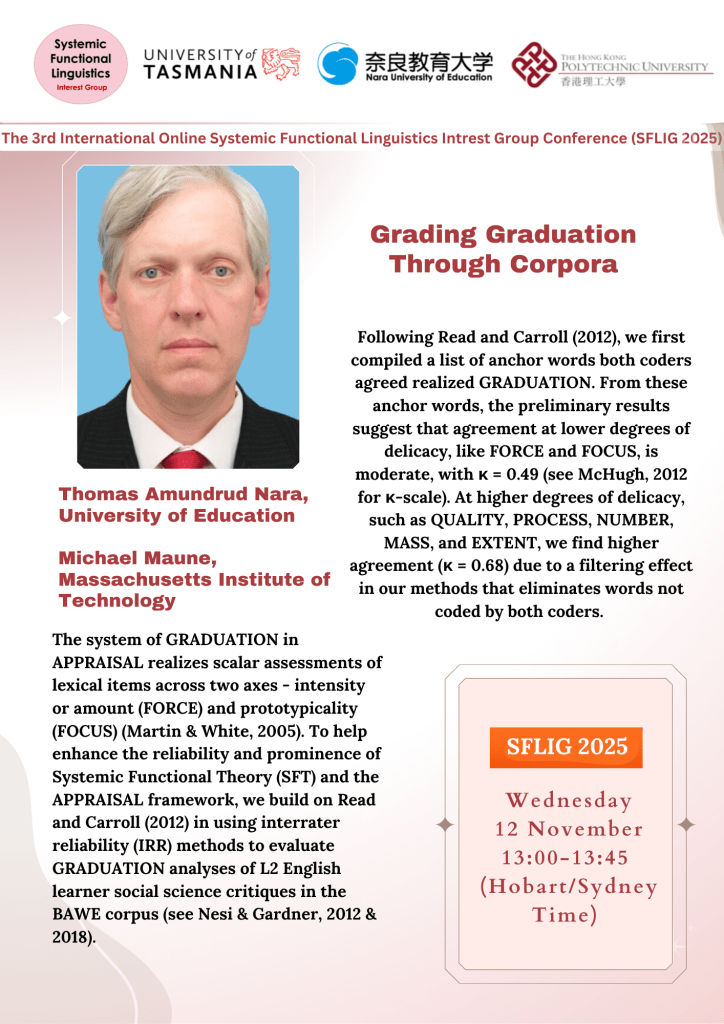
Keynote 2: Grading Graduation Through Corpora
Dr Thomas Amundrud, Nara University of Education
Dr Michael Maune, Massachusetts Institute of Technology

Abstract
The system of GRADUATION in APPRAISAL realizes scalar assessments of lexical items across two axes – intensity or amount (FORCE) and prototypicality (FOCUS) (Martin & White, 2005). To help enhance the reliability and prominence of Systemic Functional Theory (SFT) and the APPRAISAL framework, we build on Read and Carroll (2012) in using interrater reliability (IRR) methods to evaluate GRADUATION analyses of L2 English learner social science critiques in the BAWE corpus (see Nesi & Gardner, 2012 & 2018). Following Read and Carroll (2012), we first compiled a list of anchor words both coders agreed realized GRADUATION. From these anchor words, the preliminary results suggest that agreement at lower degrees of delicacy, like FORCE and FOCUS, is moderate, with κ = 0.49 (see McHugh, 2012 for κ-scale). At higher degrees of delicacy, such as QUALITY, PROCESS, NUMBER, MASS, and EXTENT, we find higher agreement (κ = 0.68) due to a filtering effect in our methods that eliminates words not coded by both coders. We found more moderate levels of agreement for parallel systems of INFUSING/ISOLATING (κ = 0.45) and UPSCALE/DOWNSCALE (κ = 0.52). We conjecture that the inconsistent levels of agreement may be attributable to factors such as systemic indeterminacy (Halliday & Matthiessen, 2014, p. 217), insufficient procedural guidance for coding in Martin & White (2005), and procedural problems arising from the complexities of international research. In this presentation, we present the background and current findings of this study, and discuss implications for the APPRAISAL system and its potential applications.
Biography
Thomas Amundrud is an Associate Professor of English Education at Nara University of Education, Japan. His dissertation (Macquarie, 2017) looked that the multimodal realization of a classroom genre of teacher-student consultation in two university EFL classrooms. His subsequent research has expanded this to Japanese secondary school EFL classrooms, incorporating Legitimation Code Theory to look at how gestures and classroom semiotic modalities like PowerPoint contribute to the teacher-student co-construction of classroom knowledge.
Michael Maune (Ph.D.) is a lecturer at Massachusetts Institute of Technology, where he teaches written and oral communication in mathematics, computer science, and political science. His research focuses on corpus-based approaches to genre pedagogy and experimental methods in SFL and Legitimation Code Theory.
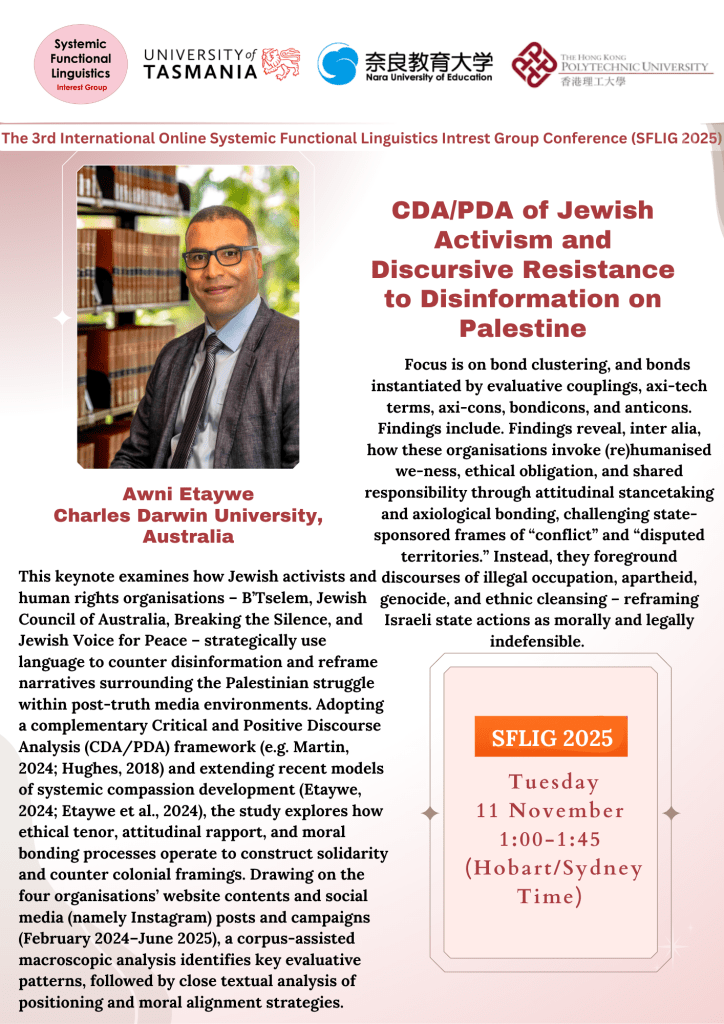
Keynote 3: CDA/PDA of Jewish Activism and Discursive Resistance to Disinformation on Palestine: Humanising We-ness, Ethical Tenor, and Moral Positioning within Shared Moral Fields
Dr Awni Etaywe, Charles Darwin University, Australia.
Abstract
This keynote examines how Jewish activists and human rights organisations – B’Tselem, Jewish Council of Australia, Breaking the Silence, and Jewish Voice for Peace – strategically use language to counter disinformation and reframe narratives surrounding the Palestinian struggle within post-truth media environments. Adopting a complementary Critical and Positive Discourse Analysis (CDA/PDA) framework (e.g. Martin, 2024; Hughes, 2018) and extending recent models of systemic compassion development (Etaywe, 2024; Etaywe et al., 2024), the study explores how ethical tenor, attitudinal rapport, and moral bonding processes operate to construct solidarity and counter colonial framings. Drawing on the four organisations’ website contents and social media (namely Instagram) posts and campaigns (February 2024–June 2025), a corpus-assisted macroscopic analysis identifies key evaluative patterns, followed by close textual analysis of positioning and moral alignment strategies.
Findings reveal how these organisations invoke (re)humanised we-ness, ethical obligation, and shared responsibility through attitudinal stancetaking and axiological bonding, challenging state-sponsored frames of “conflict” and “disputed territories.” Instead, they foreground discourses of illegal occupation, apartheid, genocide, and ethnic cleansing – reframing Israeli state actions as morally and legally indefensible. Through convergent and divergent bonding clusters, the activists balance solidarity-building and ideological disruption. They use rapport enhancement to foster compassion and co-humanity, and rapport challenge to expose systemic injustice and disinformation. These strategies, realised through legally and morally charged lexis (e.g., freedom, justice, dehumanisation, love) and semiotic icons (e.g., the apartheid wall), reconfigure power relations across nested moral fields – legal, sociocultural, institutional, and interpersonal.
The paper advances the argument that disinformation in colonial contexts functions as epistemic and symbolic violence – reconstructing truth to legitimise oppression and obscure atrocity. In response, these Jewish counter-voices emerge as alternative Jewish movements – moral and political actors who rearticulate Jewish identity around justice, co-resistance, co-humanity, and systemic compassion. Their discourse constructs “communities of truth” and “moral affiliation,” framing solidarity with Palestinians not only as a political act but as an ethical Jewish imperative grounded in shared humanity and interdependent moral orders. Ultimately, this study demonstrates how ethical and relational discourse becomes a site of moral resistance, where language re-humanises truth, contests colonial epistemologies, and activates global moral accountability.
Biography
Dr Awni Etaywe is a linguistics lecturer whose research investigates violent extremist discourse for forensic purposes and advances positive discourses of solidarity and activism. He earned his PhD from the University of New South Wales, Sydney, and has since developed a distinctive research portfolio at the intersection of language, security, and digital deviance. Dr Etaywe currently leads a national project funded by the Australian Department of Home Affairs on countering violent extremism through corpus-based and AI-assisted forensic linguistic analysis. He also co-leads the ASFLA Inc. Special Interest Group on the Semiotics of Peace, Compassion, and Empathy. His work integrates corpus and discourse analytic approaches and has been published in leading journals including Discourse & Society, Language in Society, and Discourse & Communication. Beyond academia, his expert commentary has featured in media outlets such as ABC, Sky News, Radio New Zealand, Australian Quarterly, and the New Zealand Defence and National Security Magazine – Line of Defence.
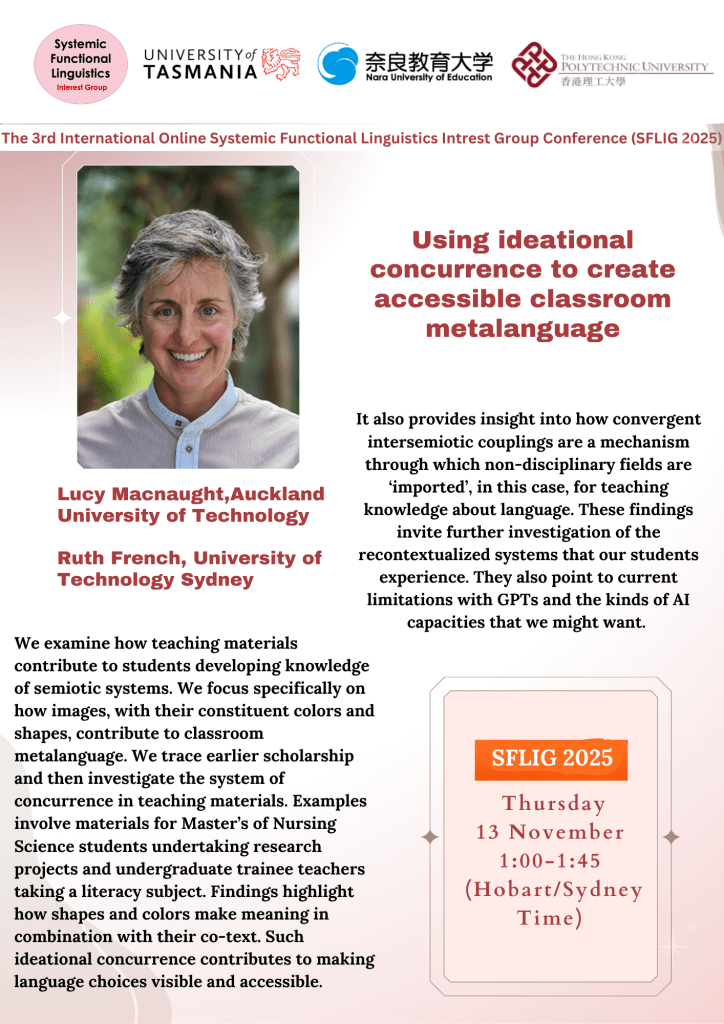
Keynote 4: Using ideational concurrence to create accessible classroom metalanguage
Dr Lucy Macnaught, Auckland University of Technology
Dr Ruth French, University of Technology Sydney
Abstract
SFL scholars have long argued that a shared metalanguage is essential for making valued meanings explicit. Metalanguage enables teachers and students to talk about types of language choices and share reasoning about when and where to deploy them. Recent research has also illuminated how a multimodal view of metalanguage, including intonation and hand movements that accompany verbiage, takes into account the relationship between what teachers and students may talk about and the dynamic process of how they talk about it. Extending Hasan’s reading of semiotic mediation, such multimodal metalanguage contributes to making what is being mediated visible to students.
In this paper, we examine how teaching materials contribute to students developing knowledge of semiotic systems. We focus specifically on how images, with their constituent colors and shapes, contribute to classroom metalanguage. We trace earlier scholarship and then investigate the system of concurrence in teaching materials. Examples involve materials for Master’s of Nursing Science students undertaking research projects and undergraduate trainee teachers taking a literacy subject. Findings highlight how shapes and colors make meaning in combination with their co-text. Such ideational concurrence contributes to making language choices visible and accessible. It also provides insight into how convergent intersemiotic couplings are a mechanism through which non-disciplinary fields are ‘imported’, in this case, for teaching knowledge about language. These findings invite further investigation of the recontextualized systems that our students experience. They also point to current limitations with GPTs and the kinds of AI capacities that we might want.
Biography
Lucy Macnaught, PhD, is a Senior Lecturer/Learning Advisor at Auckland University of Technology. Her book, Writing with Students: New perspectives on collaborative writing in EAP contexts, is currently shortlisted for the M.A.K. Halliday Book Prize. It illuminates how metalanguage and the organisation of classroom talk enables students to critique and justify their choices and teachers to guide but not provide wording. Additional research interests include GenAI for writing development and embedding academic literacy in coursework and research programs.
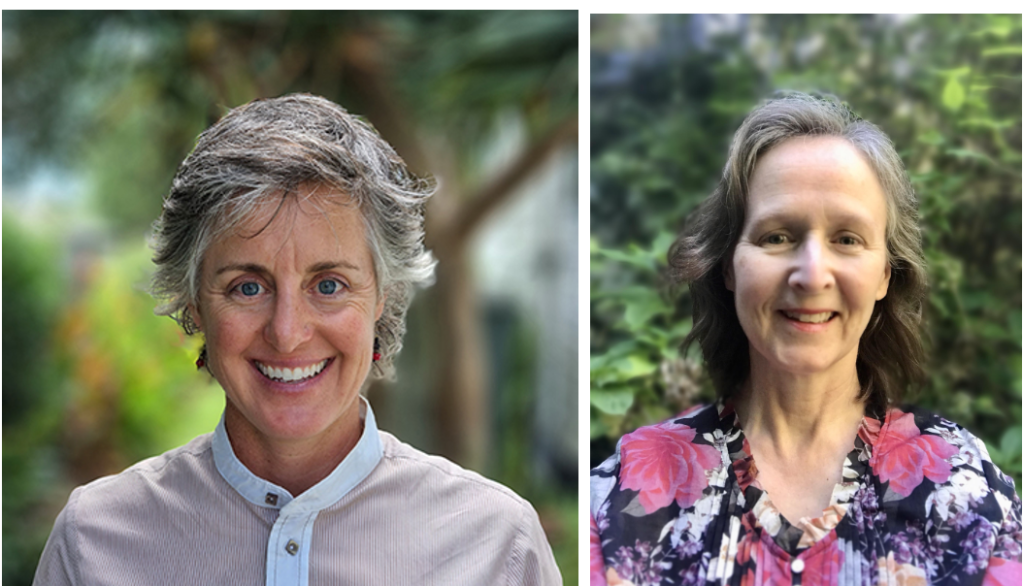
Ruth French, PhD, is a Lecturer in the School of International Studies and Education, University of Technology Sydney. Her research and teaching interests include language and literacy education, children’s literature, primary curriculum and pedagogy. A particular research interest is the development of children’s knowledge about language, including grammar.
 Systemic Functional Linguistics Interest Group (SFLIG)